
Order Editing
Edit in place. Keep every audit detail intact.
Cannabis orders don't stay still.
Lots change, quantities adjust, delivery dates move. Order Editing lets every modification flow through in real time; without forcing your customer to cancel and rebuild, and without breaking the audit trail your compliance team depends on.
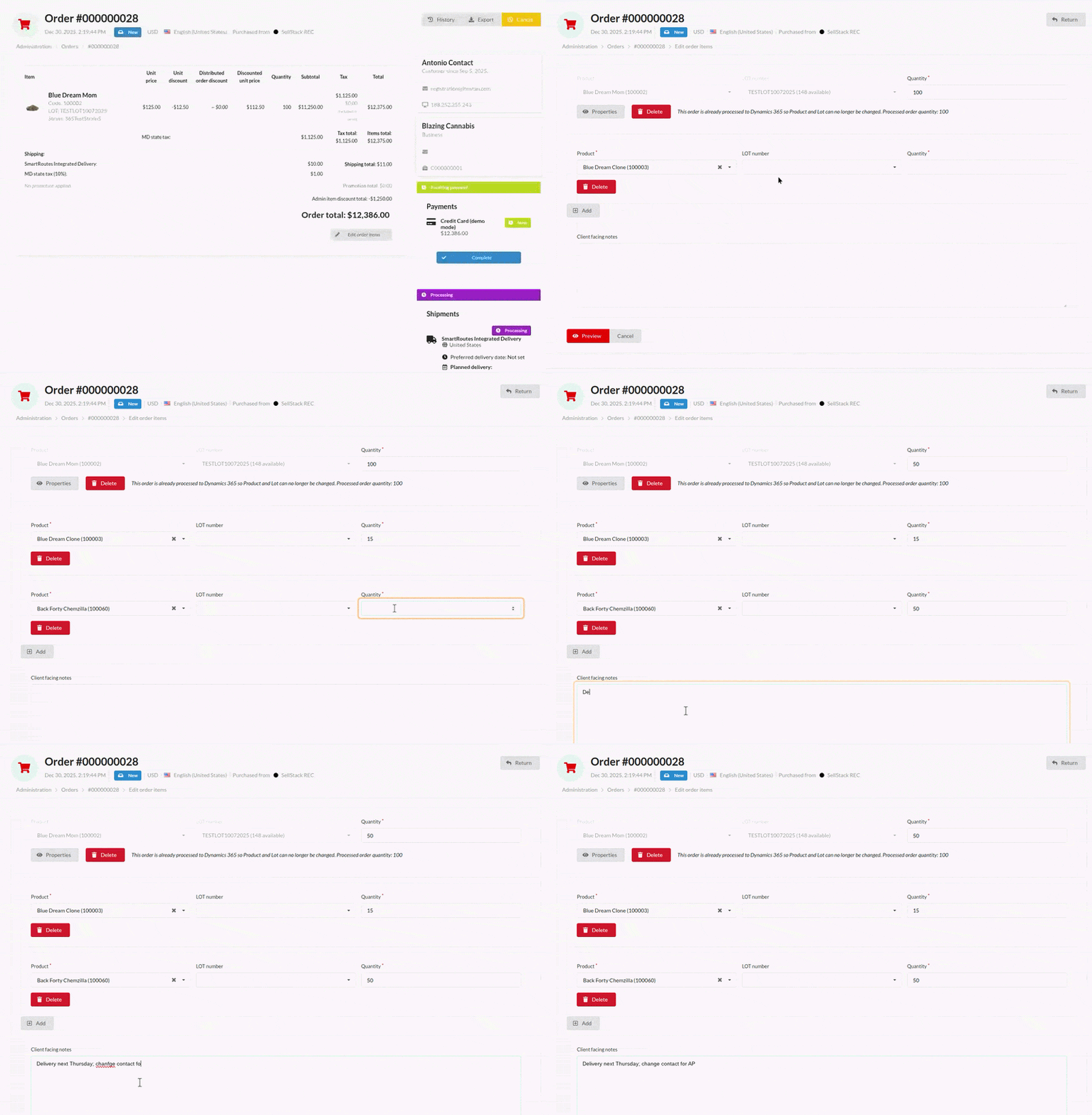
Lot Swaps Without Re-Orders
Push a different lot from inventory? Reassign on the existing order — every COA, batch ID, and compliance reference moves with it. No cancellation, no new PO number, no broken thread between Sales, Ops, and Compliance.
Quantity and Line-Level Edits
Add cases mid-flight. Remove a SKU. Convert a line from grams to eaches. Every edit recalculates pricing, taxes, and fulfillment routing automatically — and writes a clean modification record that satisfies state-reporting requirements.
Customer-Side Continuity
Your buyer never re-submits. One PO, one order number, one invoice — even when the line items underneath have changed three times. They see the latest state. You see the full history.
Protect Fulfillment SLA Through Real-World Changes
When the order changes, your delivery commitment doesn't. The clock keeps running on the original window, the warehouse keeps its pick schedule, and your customer keeps the date they expected; even after lots get swapped, lines added, or pricing renegotiated mid-order.
Honour Commercial Agility Without Operational Rework
Sales negotiates a discount Friday. Customer asks for different lots Monday. A contract pricing tier kicks in Tuesday. Every change resolves cleanly without triggering a rebuild, a re-key, or a reconciliation cycle. Your team stays selling instead of fixing.
One Order, One Truth Through Every Revision
Finance closes against one invoice. Ops fulfills against one PO. Customer service references one order number. Sales sees one customer history. Edit it as many times as reality demands; the record stays whole, the truth stays singular.
Buyer Confidence Through Smooth Revisions
Your customer never re-submits, never gets a new PO number, never has to chase down which order is the real one. They see what they expect: their original order, evolved. That's the difference between a partner platform and a transaction system.